
Referral Is a Design Problem
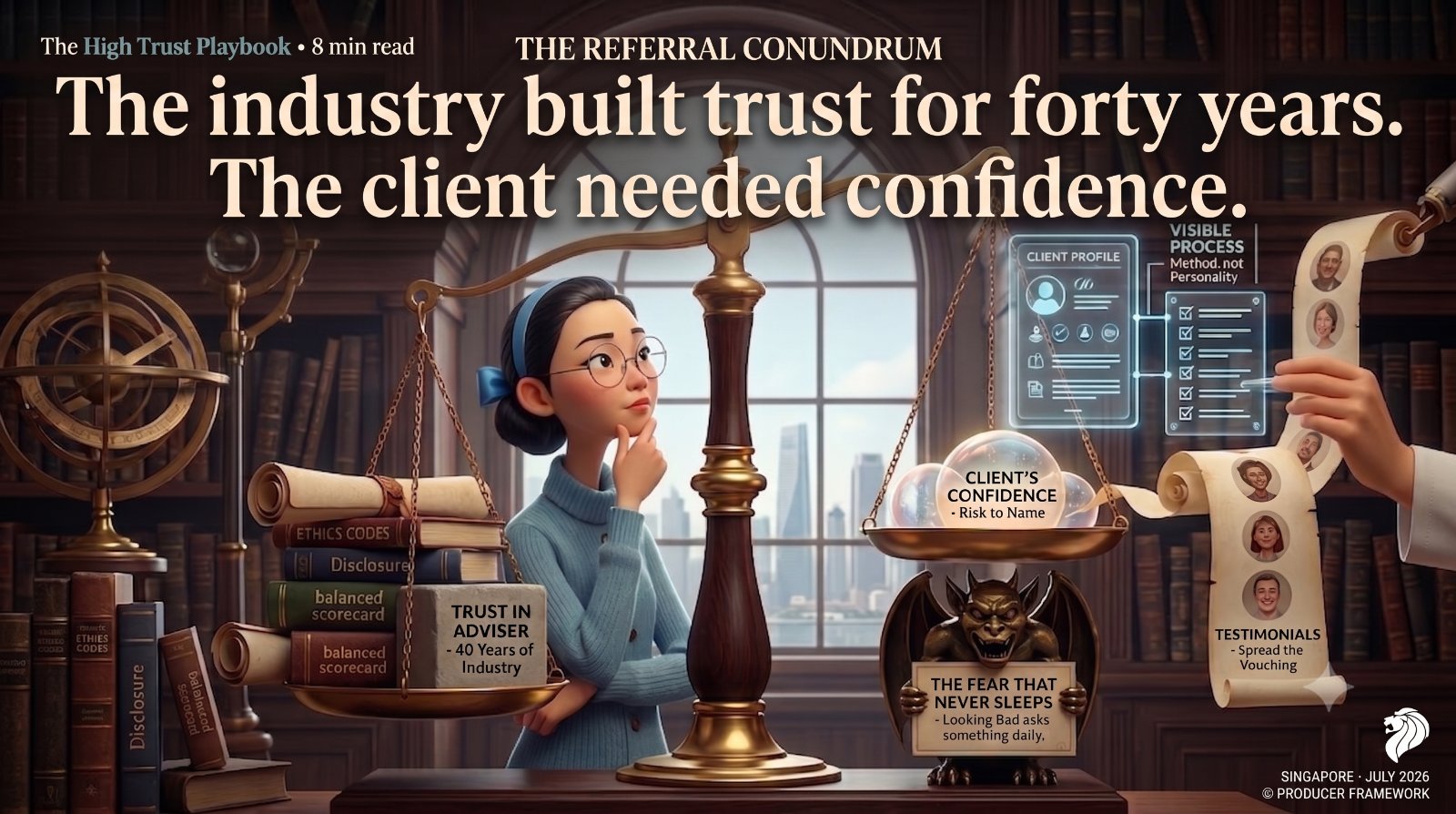
For forty years the industry taught advisers to earn trust. Clients still hold back, because saying your name to a friend puts their own name at risk. Lowering that risk is a design job, and it's the half the industry never built.

There's a scene every adviser knows.
A new client, just signed. He sat through the fact-find properly, the long meeting where you go through his money in detail. He asked good questions and took the summary home to his wife. A week later he came back and signed three policies: term, critical illness, a savings plan.
While the goodwill is still warm, the adviser asks whether anyone he knows might benefit from the same planning. And the man who just handed her his family's future softens. *Let me think about it. My friends are private about money. I'll pass your name along if anyone asks.*
Nobody ever asks. She'll raise it again at the annual review and hear the same thing, with a warmer smile.
He isn't lying, and he isn't ungrateful. He had just trusted her with his savings. Ten minutes later he would not give her one name. When the same scene repeats across practice after practice, it stops looking like bad luck. It starts looking like something built into the process.
The foundation the industry got right
For forty years the industry's answer to referral was trust. Build enough of it, and referrals were meant to follow.
The industry took that seriously. Licensing exams, continuing education, ethics codes, fact-find discipline, compliance, disclosure. An adviser today is more qualified and more accountable than ever. That work was right, and it had to be done.
Through all of it, the referral rate barely moved.
He trusted her with his savings. He would not give her one name.
When an industry pushes on one thing for forty years and the number stays flat, that thing plainly isn't the blocker. Something else is holding the client back.
What a referral really asks of the client
A referral looks like a judgment about the adviser. It's also a statement the client makes about himself, to a friend whose respect he wants to keep. He's talking about her, but his own judgment is what's on the line. His friend is about to find out whether that judgment holds up.
That raises the stakes. If the introduction goes well, the friend gets good advice and the client earns a quiet thank-you. If it goes badly, if the friend feels sold to or loses money, the client loses a little standing with someone he has to keep facing. That costs far more to repair.
When a referral goes wrong, the cost lands on the client, long after the adviser has moved on.
People feel a loss about twice as hard as a gain of the same size. Weigh the client's choice that way, and holding back is the sensible move, even when he trusts his adviser completely. Trusting her only put some money at risk. Referring her puts his name at risk. So he stays quiet.
The fear that keeps him quiet
Behind that math sits a plain human fear: looking bad in front of people whose opinion we care about. It runs quietly, all the time. Every time we recommend a restaurant or a contractor, some part of us checks first whether it could come back to embarrass us. Most days we don't notice the check. We only notice when it stops us.
A referral has to clear that check twice. Is this good for my friend? And will it make me look good? His polite objections are that check saying no in a nice way: my friends are private about money, I don't like mixing friendship and finances.
In Singapore, the risk runs heavier
Here the fear carries extra weight. When a client thinks about referring his adviser, part of him worries he'll look like he sent an "agent" after his friend. The roadshow tables, the cold calls down a contact list, the pitch at a wedding dinner. All of it sits inside that one word. So the worry in his head grows past "is she good?" into "will my friend think I set an agent on him?"
Forty years of training made individual advisers better. The reputation of the trade is a separate thing, and no single adviser can repair it alone. What an adviser can change is what the client hands over at the moment of the introduction. Give him proof his friend can check for himself, and he no longer has to stake his own word on the whole trade.
Trust and confidence are two different jobs
Trust is what the client gives the adviser: his willingness to open up and rely on her. That is the half the industry spent forty years building.
Confidence is a separate thing. It is the client's own quiet certainty that recommending her will leave him looking good. It doesn't sit inside the adviser, so building more trust never reaches it. It sits in how the client weighs his own risk. Lowering that risk is different work.
Almost none of the last forty years went into that half. As far as I can tell, no one in this industry had named it plainly, let alone built a system around it. That is the half I set out to build.
How the framework lowers the risk
Once you see the real block, the work changes from writing a better ask into designing a safer one. The client shouldn't have to stand alone behind the introduction. That is what I built the Producer Framework to do. Here is how two of its pieces work.
The profile does the talking. The client forwards one link on WhatsApp. A client testimonial sits right at the top, because what a customer says about an adviser lands harder than anything the adviser says about herself. The page makes the case. The client only presses send. If his friend reads it and isn't interested, nothing bounces back on the client, because he never made the claim himself. The page made it for him.
He refers a method, not a personality. A visible, written process and a clear financial checklist let the client say a safer sentence to his friend: "she works to a proper system." That sentence is checkable, and it doesn't stake his read of her character. If the friend's experience later falls short, it reflects on a process, not on the client's taste in people.
Every piece does one quiet job: carry the risk for the person making the introduction.
There is a deeper reason the system has to exist. The client's trust can't be handed to his friend. He earned it over meetings, a fact-find, signing in ink. His friend lived none of that. No script carries it across, and neither does a pep talk. The only thing that reaches the friend is proof he can see for himself: a testimonial, a process, a checklist. The system exists to carry what the client's word cannot.
A word on software. The industry has had CRMs, the systems that hold client records, for twenty years, and the number stayed flat. A tool nobody knows when or why to use gathers dust. What moves the outcome is the practice: knowing which move matters, and in what order. You can't buy that off a feature list, because it is a discipline.
The Producer Framework is the playbook. The software just keeps it in order.
Come back to the client who signed three policies and gave no names. He wasn't short on trust. He had proven it minutes earlier, in ink. He was simply never made to feel safe being seen recommending her. That was never his job to solve. It belongs to the system around him, and it starts with the first thing the adviser puts in front of him, long before anyone asks for a name.
If your referral rate has been flat for years, more trust won't lift it. Trust was already there. What holds your client back is the risk he carries the moment he says your name to a friend. Lower that risk by design, and referrals can follow. That is the half I built.
References
- © Producer Framework · producer.sg